What Makes an sEMG Band Good for Dexterous Decoding?
While building emg2tendon — mapping surface EMG straight to tendon control forces for a musculoskeletal hand — one constraint kept surfacing before any modeling choice: the decoder can only recover what the electrodes captured. No architecture, loss, or amount of data recovers spectral content that was aliased away at acquisition, or spatial detail that was never sampled because the channels sat over the wrong muscles.
So when the question becomes “which sEMG band should we build on,” I don’t start with price or form factor. I start with signal quality. This is a survey of eight devices we looked at, ranked by how much usable signal they hand the decoder for finger-level control — not coarse gesture classification.
The axes that actually matter
Before the table, the four axes I weigh — in order.
1. Sampling rate, against the sEMG band. Usable surface-EMG energy lives roughly between 20 and 500 Hz, with most power concentrated in the 50–150 Hz range. By Nyquist, capturing that band without aliasing wants ≥1000 Hz sampling. This is the axis people underrate:
- 250 Hz (Nyquist 125 Hz) throws away most of the band above 125 Hz. Fine for a smoothed envelope; lossy for anything that leans on high-frequency motor-unit content.
- 500 Hz (Nyquist 250 Hz) captures the bulk of usable power. Adequate, and the de-facto standard for gesture systems.
- 1000 Hz covers the classical band end-to-end.
- 2000 Hz is oversampled on purpose: headroom for MUAP-shape analysis, decomposition, and clean temporal resolution of the fast transitions that dexterity is made of.
2. Channel count and placement. Finger-level control is a spatial problem — the forearm packs a lot of extrinsic finger muscles into a small volume. Three channels give you coarse posture; eight is the workable armband density; sixteen buys real source-separation headroom. But placement beats raw count: muscle-aware electrode positioning targets specific muscles instead of a uniform ring, and a well-placed 8 can out-decode a naive 8.
3. Electrodes and SNR. Dry vs. gel, adhesive vs. armband, contact impedance, motion artifact, and drift over a session all set the noise floor your model has to fight. Specs sheets rarely quote this, so it’s the axis you validate on your own bench — but it’s why two “8 ch / 500 Hz” bands can behave very differently.
4. Readiness and pipeline velocity. Turnkey vs. build-your-own doesn’t change the signal ceiling — it changes how fast you iterate toward it. Research boards give you control over electrodes and filtering; armbands give you same-day data. A fifth, quieter factor: open datasets, which let you pretrain and benchmark before committing hardware.
The comparison
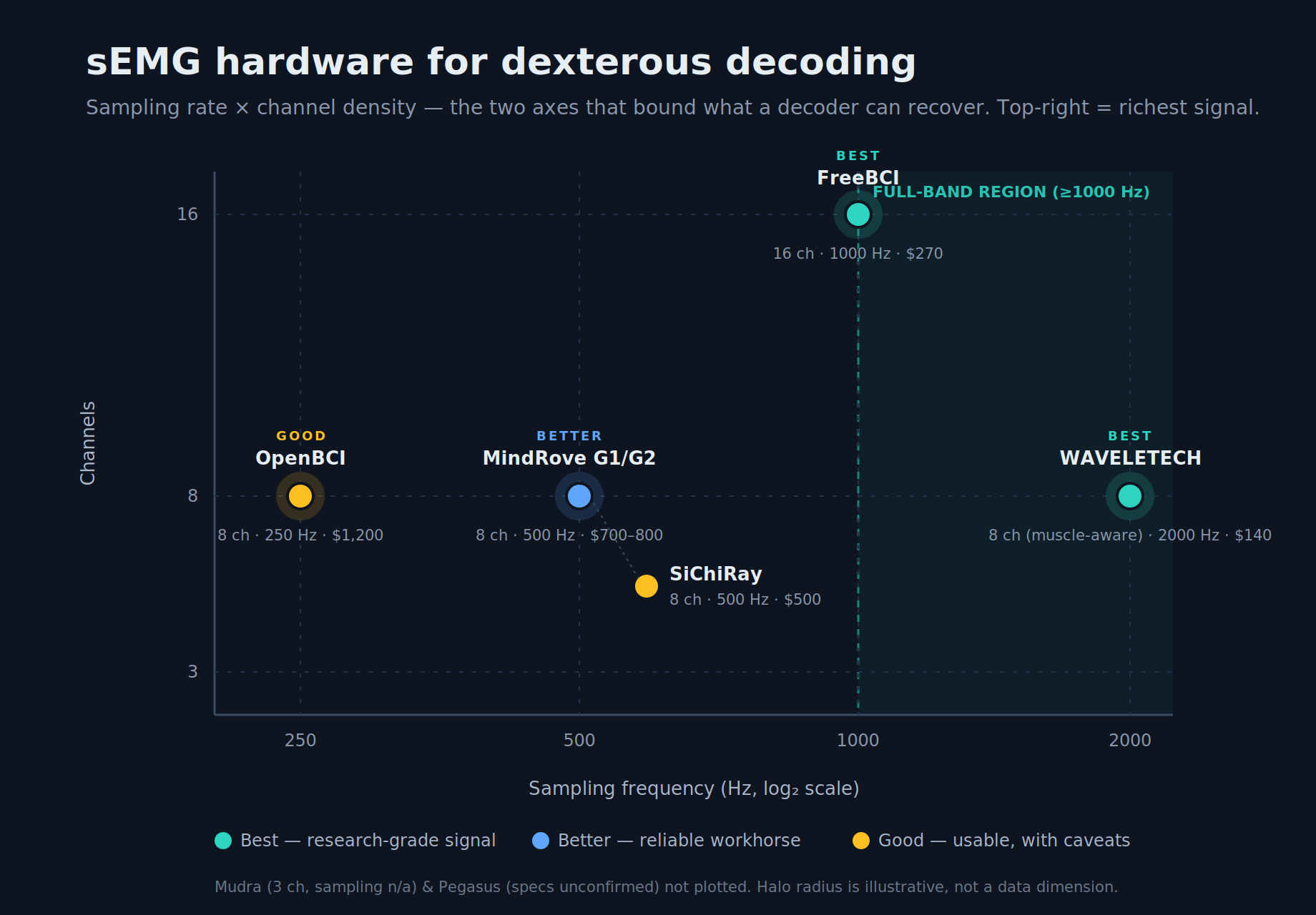
| Device | Channels | Sampling | sEMG band coverage | Ready to use | Tested by us | Price | Tier |
|---|---|---|---|---|---|---|---|
| WAVELETECH | 8 (muscle-aware) | 2000 Hz | Full + headroom | Yes | Data released (via EgoEMG) | $140 | Best |
| FreeBCI | 16 | 1000 Hz | Full band | No (build the stack) | Yes | $270 | Best |
| MindRove Gen 1 | 8 | 500 Hz | Most of band | Yes | Yes | $700 | Better |
| MindRove Gen 2 | 8 | 500 Hz | Most of band | Yes | Not yet (≈ Gen 1) | $800 | Better |
| OpenBCI | 8 | 250 Hz | Partial (< half) | No | Yes | $1,200 | Good |
| SiChiRay | 8 | 500 Hz | Most of band | Yes | Not yet | $500 | Good |
| Pegasus | — | — | Unconfirmed | Yes | Not yet | $180 | Good |
| Mudra | 3 | — | Coarse only | Yes | No | $250 | Coarse control |
The ranking, and why
Best — research-grade signal
WAVELETECH is the standout on a pure signal-per-dollar basis: 8 muscle-aware channels at 2000 Hz for $140, with data already released through the EgoEMG effort. The high sampling rate and targeted placement are exactly what a fine-grained decoder wants, and open data means you can validate the pipeline before the band even ships. The honest caveat is procurement and support — it’s a Chinese-market device, so factor sourcing and documentation into your timeline.
FreeBCI has the highest raw ceiling here: 16 channels at 1000 Hz for $270. That’s the most spatial resolution and full-band capture in the set. The trade is readiness — you build the firmware, streaming, and electrode setup yourself. For a lab willing to invest in the stack, it’s the strongest signal foundation on the list; for a team that needs data this week, it’s a project.
Better — reliable workhorse
MindRove Gen 1 / Gen 2 is what I reach for when reliability matters more than squeezing the last bit of bandwidth. Eight channels at 500 Hz, a real SDK, clean don/doff, turnkey streaming. 500 Hz is adequate rather than full-band, and at $700–800 you’re paying for the ecosystem and support — often worth it. Gen 2 we haven’t benchmarked, but it should track Gen 1.
Good — usable, with caveats
OpenBCI is the most flexible and best-documented platform in the set, with a large community and configurable electrodes. But for dedicated sEMG its 250 Hz cap undersamples the band, and at $1,200 it’s the most expensive here. Great for teaching, prototyping, and mixed EEG/EMG work; not my first choice for high-fidelity dexterous decoding.
SiChiRay looks like a lower-cost MindRove analogue on paper — 8 ch, 500 Hz, $500, turnkey — but we haven’t validated its SNR or artifact behavior, so it sits in “promising, unverified.”
Pegasus is the budget wildcard at $180, but with channel count and sampling rate unconfirmed, I can’t place it on signal quality yet. Worth a look once specs are pinned down.
Mudra is a well-made consumer neural wristband, but 3 channels put it firmly in coarse, discrete-gesture territory. For a few reliable commands it’s fine; for finger-level dexterity it’s simply under-provisioned.
Bottom line for dexterous manipulation
If you’re decoding for dexterity, weight the axes in this order: sampling ≥1000 Hz, then ≥8 well-placed channels, then readiness. My picks today:
- Research decoder, best signal-per-dollar: WAVELETECH — provided you can source it.
- Maximum signal ceiling, willing to build: FreeBCI.
- Turnkey and dependable: MindRove.
The rest are situational. And whatever you choose, remember the framing that started this: your model inherits the ceiling your electrodes set. Spend the effort there first.